Last year when my course on "Introduction to Social Entrepreneurship" grew into a 2-term course, it threw open a new opportunity to provide the students a short internship/attachment with a social venture during the term-break.
The purpose of the internship/attachment was to give them a ground-level feel of ventures in this sector - their learning came through their interactions with the functionaries and staff, by visiting the project sites and interacting with customers/beneficiaries; if they could do a short field project (though the time was limited - just about 7-10 days), that was invaluable.... and then when they returned, we shared the stories and learned from each other.
This year too, the 35 participants of the course have identified their areas of interest and we could find social ventures (for-profits, not-for-profits, NGOs), which are willing to host them for 7-10 days.
Here is the list:
Bhumi (Hyderabad)
http://bhumi.in/
BHUMI is a "Center for learning transformational Grass Roots Leadership" fuelled by a vision to create an equitable and strife free society by grooming transformational leaders who will bring about large scale, holistic and sustainable transformation.
Biotech India (Thiruvantpuram)
http://www.ashdenawards.org/winners/biotech
Getting rid of waste, both food and human, is essential to hygiene. But waste is also a cost-effective and sustainable source of fuel. Since 2004 Biotech-India - the recepient of the Ashden Award for 2007 - has improved the lives of hundreds of thousands of people in Kerala, Southern India and saved several thousand tonnes per year of CO2 simply by getting rid of waste.
Children's Rights in Goa (Goa)
http://childrightsgoa.org/
Children's Rights in Goa (CRG) is involved in child protection and the advocacy of children's rights. CRG is dedicated to the goal of improving the status of children in Goa. It strives to create awareness about the rights of the child and is committed to protecting children from sexual abuse and all forms of exploitation.
Conserve India (Delhi)
http://www.conserveindia.org/
Born of a desire to reduce India's rubbish mountain, improve energy efficiency, and help some of Delhi's poorest out of the city's slums, Conserve India achieves all this by turning plastic bags into high fashion.
Desi Crew Solutions Pvt Ltd (Chennai)
http://www.desicrew.in/
DesiCrew Solutions Pvt. Ltd - winner of Sankalp 2009 Award and recepient of the Manthan Award - is a rural BPO company, incubated by RTBI of IIT- Madras. By setting up IT enabled service centers in rural areas, it provides meaningful livelihood to educated people of rural & semi-urban India.
Financial Information Network & Operations Ltd. (FINO) (New Delhi)
http://www.fino.co.in/
FINO - winner of Global Financial Times "banking at the bottom of pyramid award" - provides electronic banking technologies to enable financial institutions (FIs) to serve the under-served and the unbanked sector and also to service the technology requirements of entities engaged in servicing the bottom of pyramid customers.
Health Management and Research Institute (HMRI) (Hyderabad)
http://www.hmri.in/
HMRI is a nonprofit organization working towards improved access and quality of healthcare services for all. HMRI leverages state-of-the-art information and communication technologies and modern management practices to transform healthcare delivery by creating the world’s largest integrated digital health network.
Mirakle Couriers (Mumbai)
http://www.miraklecouriers.com/
Mirakle Couriers - winner of Helen Keller Award 2009 and recepient of Echoing green Fellowship 2008 - is a courier company with a difference; the venture provides livelihood to deaf people from underprivileged background, while providing professional service to some of the well-known corporate clients.
Palsa Pally Unnayan Samity (Mushirabad)
http://www.karmayog.org/ngo/PPUS
PPUS is an NGO which works to develop poor rural communities in the Murshidabad District to promote communal harmony, gender equity, and neutralisation of caste, creed and religion. It does so by by providing healthcare and education, and facilitating active community participation in self-governance, .
Pratham (Patna)
http://www.pratham.org/
Pratham is the largest non governmental organisation working to provide quality education to the underprivileged children of India. Pratham was established in 1994 to provide education to the children in the slums of Mumbai city. Since then, the organization has grown both in scope and geographical coverage.
Pravah (New Delhi)
http://www.pravah.org/
Pravah works with adoloscents and diverse groups like youth organizations and institutions to impact issues of social justice through youth citizenship action. Its programs aim to promote internalisation of social orientation and regard for common spaces, and to develop socially responsible decision makers of the future.
Priyasakhi Mahila Sangh (Indore)
http://psmssm.org/
Priyasakhi Mahila Sangh promotes development and livelihood activities for the underprivileged of the society. The organisation specifically works with women to strenghten women SHGs in rural and urban areas of different districts of Madhya Pradesh
Project Why (New Delhi)
http://www.projectwhy.org/
Project Why is a New Delhi (India) based non-profit organisation engagedin education support and life skill enhancement of slum children and their families. It works to create a model whereby quality education support in underprivileged areas can be provided by pooling community resources.
RAICO (Ranchi)
Some RAICO Products
RAICO is a young start-up, which works with 350 rural women of Jharkhand, and uses and enhances their skills to make and market designer hand-woven, hand-embroidered apparels and artificial jewelery.
Rang De (Chennai)
http://www.rangde.org/
Rang De is a non profit entity which aims to make low cost microcredit a reality for people to whom even ‘traditional microcredit’ is unaffordable. It does so by enabling individuals to become online social investors, and brings microcredit and online lending to the forefront, thus bringing down the cost of microcredit
Sasha (Kolkata)
http://www.sashaworld.com/
Sasha is the not-for-profit marketing outlet for more than a hundred groups of craftspersons and producers from all over the country. Apart from marketing, Sasha also involves itself in the formative stages of craft groups. Sasha works with these groups to revive crafts and develop new designs and techniques.
SOS Children's Villages India (Bawana)
http://www.soscvindia.org/
SOS Children's Villages is a non-governmental social organisation, which provides family-based long-term care, education and development of orphaned and abondoned children through its "villages".
Ujjivan (Bangalore & Delhi)
http://www.ujjivan.com/mission_goals.htm
Ujjivan is an micro-finance organisation - with 500 branches in urban and rural India - which provide financial services to the economically active poor, to enable them to lead a ‘better life’. It also participates in a holistic approach to poverty reduction through a partnership with Parinaam NGO by collaborating with institutions focused on childcare, education, health, vocational training, community development, shelter and disaster relief.
URAVU (Wayanad)
http://www.uravu.net/
URAVU provides livelihood to the marginalized and economically disadvantaged social groups, especially the traditional artisans, women and the indigenous people, through end-to-end bamboo-processing and producing eco-friendly handicraft products.
Women’s Interlink Foundation (Kolkata)
http://www.womensinterlinkfoundation.org/
WIF is a Kolkata-based organisation which works with disadvantaged women, children and communities (specifically with sex-workers, abondoned and trafficked children and women) to provide them with access to basic amenities and societal resources, and empowers the to improve their quality of life.

Friday, August 20, 2010


Saturday, August 14, 2010
Hamara Footpath: Restoring Childhoods
Mumbai-based Hamara Footpath is a community effort taking responsibility for its city and for its children who are deprived of their childhood on the streets. It engages engage volunteers to educate children living on the streets through creative, fun and participatory methods.
Read more about them here.
Or, better still, if you are in Mumbai, and want to support what they are doing, participate in their "Fashion Street" initiative on Aug 14-15, 2010

Click on the image to view the details
Read more about them here.
Or, better still, if you are in Mumbai, and want to support what they are doing, participate in their "Fashion Street" initiative on Aug 14-15, 2010

Sunday, July 25, 2010
Driving the folkswagon
Kalamandir started with "a vision to foster necessity and accessibility of arts and aesthetics in our day to day social life. Countering the mono culture, the venture looks for a creative, dynamic and diversified environment for the young minds among tribes and non-tribes of Jharkhand - who are fiull of finer senses."
In doing so, it has not only revived the dying tribal arts, but also now supports 2500 families, and has built up a "social business venture" with a turnover of Rs.1crores.
This story about Kalamandir was published a few months back:
 It was a visit to the workshop of an impoverished stone sculptor in 1980 that chiselled out Amitava Ghosh's mission in life. The young banker and amateur theatre artist had just arrived in Jamshedpur, then a part of Bihar. Three decades on, villagers in the Singhbhum-Kolhan region hail him as the man who has revived four dying art forms, bankrolling a clutch of struggling artists, providing livelihood to 2,500 families, and inspiring hundreds to live by their art. "I met this sculptor named Guntha Laik on a visit to Chandil village. He had lost his house and farmland to the Subarnarekha dam project," Ghosh said. Moved by his plight, Ghosh started making regular trips to Chandil to explore ways of aiding Laik. "I tried to help him with funds, but couldn't do much."
The failure haunted Ghosh, then a 21-yearold fresh out of Kolkata's Scottish Church college, for years. His chance for redemption came in the mid- '90s, when he learnt about the dying tribal metal art of Dokra. "I visited Chakulia's Bend village to meet the last surviving Dokra artist. Phatik Rana had recently given up the trade to earn his living by working in farms," said Ghosh. "It was depressing to see an artist working the plough."
It took Ghosh five years to goad Rana back into his trade. Today, Rana is recognised for his skills - his products fetch him up to Rs 9,000 per month - and he is an icon for a generation of younger artists. In his village alone, more than 100 youngsters now make Dokra and earn almost as much as Rana does.
Ghosh also walked an extra mile for Kedar Nath Sahu, the Chhau dancer of Saraikela. The art, once the toast of tribal performances at the Rashtrapati Bhavan and stages in China and Russia, tottered on the brink of extinction while Sahu himself was plunged in poverty. Ghosh got Sahu to draw up a blueprint for a profitable revival of the mask dance. In 2001, he organised the first Chhau Mahotsav - the pivot on which the dance made a turnaround. Ghosh subsequently set up the State Chhau Centre at Saraikela to lend institutional support to the artists. Sahu, meanwhile, went on to bag the Padma Shri in 2004.
Ghosh took up another challenge - the revival of Firkal, a traditional war dance. He trained Potka village's womenfolk to make products from grass and bamboo to support their dancer husbands. Over the last four years, more than 500 wives have coaxed their men to perform Firkal and leave the earning to the women.
In doing so, it has not only revived the dying tribal arts, but also now supports 2500 families, and has built up a "social business venture" with a turnover of Rs.1crores.
This story about Kalamandir was published a few months back:
 It was a visit to the workshop of an impoverished stone sculptor in 1980 that chiselled out Amitava Ghosh's mission in life. The young banker and amateur theatre artist had just arrived in Jamshedpur, then a part of Bihar. Three decades on, villagers in the Singhbhum-Kolhan region hail him as the man who has revived four dying art forms, bankrolling a clutch of struggling artists, providing livelihood to 2,500 families, and inspiring hundreds to live by their art. "I met this sculptor named Guntha Laik on a visit to Chandil village. He had lost his house and farmland to the Subarnarekha dam project," Ghosh said. Moved by his plight, Ghosh started making regular trips to Chandil to explore ways of aiding Laik. "I tried to help him with funds, but couldn't do much."
 The failure haunted Ghosh, then a 21-yearold fresh out of Kolkata's Scottish Church college, for years. His chance for redemption came in the mid- '90s, when he learnt about the dying tribal metal art of Dokra. "I visited Chakulia's Bend village to meet the last surviving Dokra artist. Phatik Rana had recently given up the trade to earn his living by working in farms," said Ghosh. "It was depressing to see an artist working the plough."
It took Ghosh five years to goad Rana back into his trade. Today, Rana is recognised for his skills - his products fetch him up to Rs 9,000 per month - and he is an icon for a generation of younger artists. In his village alone, more than 100 youngsters now make Dokra and earn almost as much as Rana does.
Ghosh also walked an extra mile for Kedar Nath Sahu, the Chhau dancer of Saraikela. The art, once the toast of tribal performances at the Rashtrapati Bhavan and stages in China and Russia, tottered on the brink of extinction while Sahu himself was plunged in poverty. Ghosh got Sahu to draw up a blueprint for a profitable revival of the mask dance. In 2001, he organised the first Chhau Mahotsav - the pivot on which the dance made a turnaround. Ghosh subsequently set up the State Chhau Centre at Saraikela to lend institutional support to the artists. Sahu, meanwhile, went on to bag the Padma Shri in 2004.
Ghosh took up another challenge - the revival of Firkal, a traditional war dance. He trained Potka village's womenfolk to make products from grass and bamboo to support their dancer husbands. Over the last four years, more than 500 wives have coaxed their men to perform Firkal and leave the earning to the women.
Sunday, July 11, 2010
How I became a social entrepreneur? - The "Dream a Dream" Story

Vishal Talreja, an Ashoka Fellow, founded Dream A Dream in 1999 at the age of 20. The venture seeks to empower children from vulnerable backgrounds by developing life skills and at the same time sensitizing the community through active volunteering leading to a non-discriminatory society where unique differences are appreciated. Over the years, Dream a Dream has enhanced the lives of about 3000 children from vulnerable backgrounds and engaged over 1500 active volunteers who represent an increasingly sensitive community.
Here is the story of "how I became a social entrepreneur" from the horse's mouth:
...and what Dream a Dream does, and How:
Friday, July 09, 2010
5 Social Entrepreneurs @ XLRI - what did we learn?
A follow-up on the previous post
 So here we had two interactions - "On Becoming a Social Entrepreneur" & "Issues in Social Engagement" - with 5 people with a "track-record" for their engagement/contribution to make a social impact on July 7th:
someone who started with 67 clothes in 1998, and built and organisation which now collects, sorts and reaches 50,000kg of wearable clothes to villages in more than 20 states across the country
someone who started with an idea and an internet "pledge-campaign" and built the largest public library in the state
someone who started with running a vocational training in a local college for students, and has now scaled up to run 20-odd centers which provide employability skills training in the region to the less-privileged and get them into mainstream...
someone who started with an intention to "give back to the society" and has helped the local community to start many initiatives
someone who started with a turnover of Rs.4000/- in 2001 trying to provide livelihoods to rural communities, so that he can help preserving the local tribal art, and now has an organisation with a turnover of Rs.1 crores
So what did we learn?!!
The best I could think was to invite the students of the ISE (Intro to Social Entrepreneurship) class (including me:) to send their short description of take-away from these interactions...
 (and ...though we had a gathering of more than the 35-odd class size in these 2-sessions - those not in the course.. some actually not even from XL:) - and they would have taken their learning with them)...and much of our life-changing learning is 'implicit" than "explicit"...)
...here is a compilation of our take-aways - what we learned - which I could get from some of those 35+... what they (and I) remembered and learned from the interaction
----

"I never even knew how many e's are there in "entrepreneurship" when I started. I was just following an idea I was passionate about."
If you have to think about jumping into the social sector, then you're probably not ready for it.
If you start early, you have more time to make mistakes and learn from them... There is no escaping from making mistakes, if you want to become an entrepreneur.
Entrepreneurship is like proposing a girl. You need passion, guts and you need to be crazy enough to do it.
India has huge population, therefore huge number of problems., therefore solutions required for those problems will be huge, therefore social entrepreneurs required for solving the problems will be huge in number.
Think big but act small. Every action, big or small, shall eventually help in scaling up. Don't allow the overall vision to hamper your daily progress.

Teach poor children who cant pay their school's fee. Feed the hungry every year (around 500-1000 people), atleast twice during festivals. Doing these things doesn't require much time, doesn't require you to leave your job (for which we have also worked hard) and doesn't deplete you of your hard earned money much. It doesn't make you famous, but it will make a difference!!
Every one wants to be an Entrepreneur first and then think about social cause. 1.2 million NGO's (that's what I heard, I think) and numerous entrepreneurs and still the country's not improving. Lets be dedicated to the social cause not to our cause.
Stop Talking Start Doing

"Dont try to solve India's or world's problems. Start by solving problems which you see around you."
Somehow gave me a feeling that entrepreneurship lies in the "possible domain" and not the "impossible domain"...
Try to get rid of "Escapism": today I have to pay my education loan, tomorrow I have to pay my housing loan and so on.... this is a trap from which a person would not be able to come... act now, and if one is passionate about his idea, then in a period of year or so, he would definitely find some way to overcome his other liabilities.
Where there is a will there is a way

"Yes, you need to pay the 'education loan' when you get a job. If you jump into entrepreneurship, why start with an assumption that you won't be able to pay it after a year?"
Think big but there is no harm in starting small... Don't let the hurdles stop you.. they will be taken care of once you jump in! .. You learn to improvise...
"We are country of volumes , problems are in volume, solutions required are in volumes and people required to address these problems are in volumes"
I have never understood entrepreneurship - forget what is "social entrepreneurship"... In a way, we are all social entrepreneurs; I think the only entrepreneurial act is proposing to a girl - it has risks, hope... sometimes even a "business plan" :)
No matter what one's way of doing good is (profit or non-profit), as long as the end result remains 'good', the value of the effort always justifies the effort....in whatever form it be.

One major learning I had, about being a social entrepreneur is that, it’s a matter of following what you really want deep inside... if you recollect, every speaker mentioned about ‘giving back something to the society’, and getting a mental satisfaction... I think most people have that urge, but are plainly not bold enough to leave our comfort zone and to do something that challenges your foundations. And there lies the difference between being mediocre and being someone who can bring a change in the lives of at least a handful of people, at the same time making it sustainable for yourself. Only once you get out of that zone, & start doing something which gives you inner fruits ( internal satisfaction-which i think, only money can never bring in ) and initiate or be part of a change for good, you will understand that by helping the society- I’m helping myself like never before... All these leads to an understanding that, Social entrepreneurship is – ‘helping others to help yourself’

Most of us don't want to leave the comfort zone of security(money, family etc). Though to some extent moving into Social Sector can test you in these aspects but with a viable model one can easily overcome this. Sujit and Anshu makes one feel that if not now, then when. There are lots of opportunities to be tapped and market is huge. :-) enough for everyone to accommodate to make a mark and contribute.
Everyone can start in their own small way.
---------
and of course, we also had the inauguration of "Udaan"- XLRI's Children's Public Library after the sessions :0))
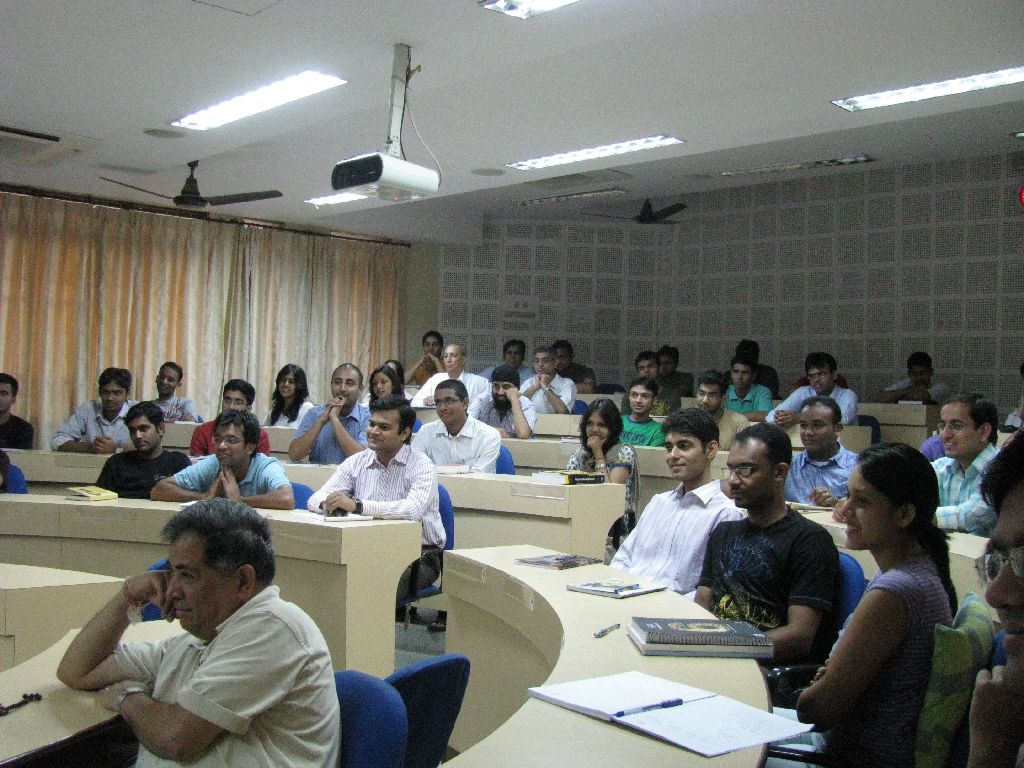 So here we had two interactions - "On Becoming a Social Entrepreneur" & "Issues in Social Engagement" - with 5 people with a "track-record" for their engagement/contribution to make a social impact on July 7th:
So what did we learn?!!
The best I could think was to invite the students of the ISE (Intro to Social Entrepreneurship) class (including me:) to send their short description of take-away from these interactions...
 (and ...though we had a gathering of more than the 35-odd class size in these 2-sessions - those not in the course.. some actually not even from XL:) - and they would have taken their learning with them)...and much of our life-changing learning is 'implicit" than "explicit"...)
...here is a compilation of our take-aways - what we learned - which I could get from some of those 35+... what they (and I) remembered and learned from the interaction
----


Everyone can start in their own small way.
---------
and of course, we also had the inauguration of "Udaan"- XLRI's Children's Public Library after the sessions :0))
Tuesday, July 06, 2010
Social Entrepreneurs to visit XLRI - July 7th '10
7th July is going to be an eventful day at XLRI Jamshedpur.
We have two discussions - "One Becoming a Social Entrepreneur" and "Issues in Social Engagement" scheduled with with some of the most committed social entrepreneurs of different hues and "models". They are for-profit, not-for-profit, volunteerism-based, hybrid models... but have one common base: Their purpose is to create constructive and inclusive social change.
Somewhere in between, we will also inaugurate the Children's Public Library, Udaan, which SIGMA has created for the kids of our maintenance staff and domestic helps... actually for all campus kids (and we hope that this becomes a replicable model for various colonies, campuses, housing complexes)...
...and we top it with the first meeting of the "core group" to discuss the 2nd edition of "Jamshedpur JoyFest - The Joy of Giving Week 2010" (Sept 26- Oct 2, 2010) in the evening.
So, who all are the social entrepreneurs visiting XLRI?
 Amitava Ghosh
Founder/Director, Kala Mandir,
Jamshedpur
Kala Mandir works to preserve and promote tribal arts in Jharkhand by creating local communities, and providing them with sustainable livelihood options through micro-enterprise development, market-linkages, education, opportunities for eco-tourism, etc.
 Anshu Gupta
Founder/Director, GOONJ
New Delhi
GOONJ works with the issue of clothing, and recycles anything which is discarded as urban waste into resources for others, and works across 20 states. The venture has been internationally recognized for its work and has been the recipient of Changemakers Innovation Award 2004 &2006, World Bank’s Development Marketplace Award 2007 and NGO of the Year Award 2007.
 Ronny D'Costa
Regional Governer, Rotary International
Rotary International has been a fore-runner in promoting constructive social engagement and volunteerism across different sections of society. As a committed Rotarian, Ronny has been instrumental in the implementation of a number of projects, e.g., rainwater harvesting, clothes bank, healthcare, education and literacy, etc.
 Santanu “Sunny” Bhattacharya
Founder/Director, Technable Solutions Pvt Ltd,
Kolkata
Technable Solutions Provides employability skill training to youth, and runs about 20 centers in WB and North-East. For its work, Technable Solutions was selected as the finalist for the Sankalp Awards 2010, and was awarded the Social Enterprise Leadership Award (International) by Social Enterprise Alliance (USA).
 Sujit Mahapatra
Founder/Director, Bakul Foundation
Bhubneshwar
Bakul Foundation works to promote education, volunteerism and social engagement among youth. The Bakul Library, is the largest public library in Orissa, and is supported entirely by volunteers. It campaigns to promote environmental consciousness, art, etc. have received wide recognition.
We have two discussions - "One Becoming a Social Entrepreneur" and "Issues in Social Engagement" scheduled with with some of the most committed social entrepreneurs of different hues and "models". They are for-profit, not-for-profit, volunteerism-based, hybrid models... but have one common base: Their purpose is to create constructive and inclusive social change.
Somewhere in between, we will also inaugurate the Children's Public Library, Udaan, which SIGMA has created for the kids of our maintenance staff and domestic helps... actually for all campus kids (and we hope that this becomes a replicable model for various colonies, campuses, housing complexes)...
...and we top it with the first meeting of the "core group" to discuss the 2nd edition of "Jamshedpur JoyFest - The Joy of Giving Week 2010" (Sept 26- Oct 2, 2010) in the evening.
So, who all are the social entrepreneurs visiting XLRI?
 Amitava Ghosh
Founder/Director, Kala Mandir,
Jamshedpur
Kala Mandir works to preserve and promote tribal arts in Jharkhand by creating local communities, and providing them with sustainable livelihood options through micro-enterprise development, market-linkages, education, opportunities for eco-tourism, etc.
 Anshu Gupta
Founder/Director, GOONJ
New Delhi
GOONJ works with the issue of clothing, and recycles anything which is discarded as urban waste into resources for others, and works across 20 states. The venture has been internationally recognized for its work and has been the recipient of Changemakers Innovation Award 2004 &2006, World Bank’s Development Marketplace Award 2007 and NGO of the Year Award 2007.
 Ronny D'Costa
Regional Governer, Rotary International
Rotary International has been a fore-runner in promoting constructive social engagement and volunteerism across different sections of society. As a committed Rotarian, Ronny has been instrumental in the implementation of a number of projects, e.g., rainwater harvesting, clothes bank, healthcare, education and literacy, etc.
 Santanu “Sunny” Bhattacharya
Founder/Director, Technable Solutions Pvt Ltd,
Kolkata
Technable Solutions Provides employability skill training to youth, and runs about 20 centers in WB and North-East. For its work, Technable Solutions was selected as the finalist for the Sankalp Awards 2010, and was awarded the Social Enterprise Leadership Award (International) by Social Enterprise Alliance (USA).
 Sujit Mahapatra
Founder/Director, Bakul Foundation
Bhubneshwar
Bakul Foundation works to promote education, volunteerism and social engagement among youth. The Bakul Library, is the largest public library in Orissa, and is supported entirely by volunteers. It campaigns to promote environmental consciousness, art, etc. have received wide recognition.
Sunday, July 04, 2010
SAATH: Creating Inclusive Cities
 Healthcare, slum education, micro-finance, youth and women’s employment… Ahmedabad-based SAATH has myriad programmes to improve the lot of the urban poor. In some way, its initiatives can be likened to a complex web that touches every corner of their lives. “This web is not to trap, but a mechanism to uplift the urban poor,”...
SAATH utilizes market-based strategies to create inclusive societies by empowering India's urban and rural poor.
SAATH's integrated approach brings all services that a poor community could need together in one centre, simplifying life for Bottom-of-Pyramid Indians....
Also read this article...
Subscribe to:
Posts (Atom)